
An Artist Talk on Thresholds, Fiber Optic Art, and the Space Between Who We Were and Who We're Becoming
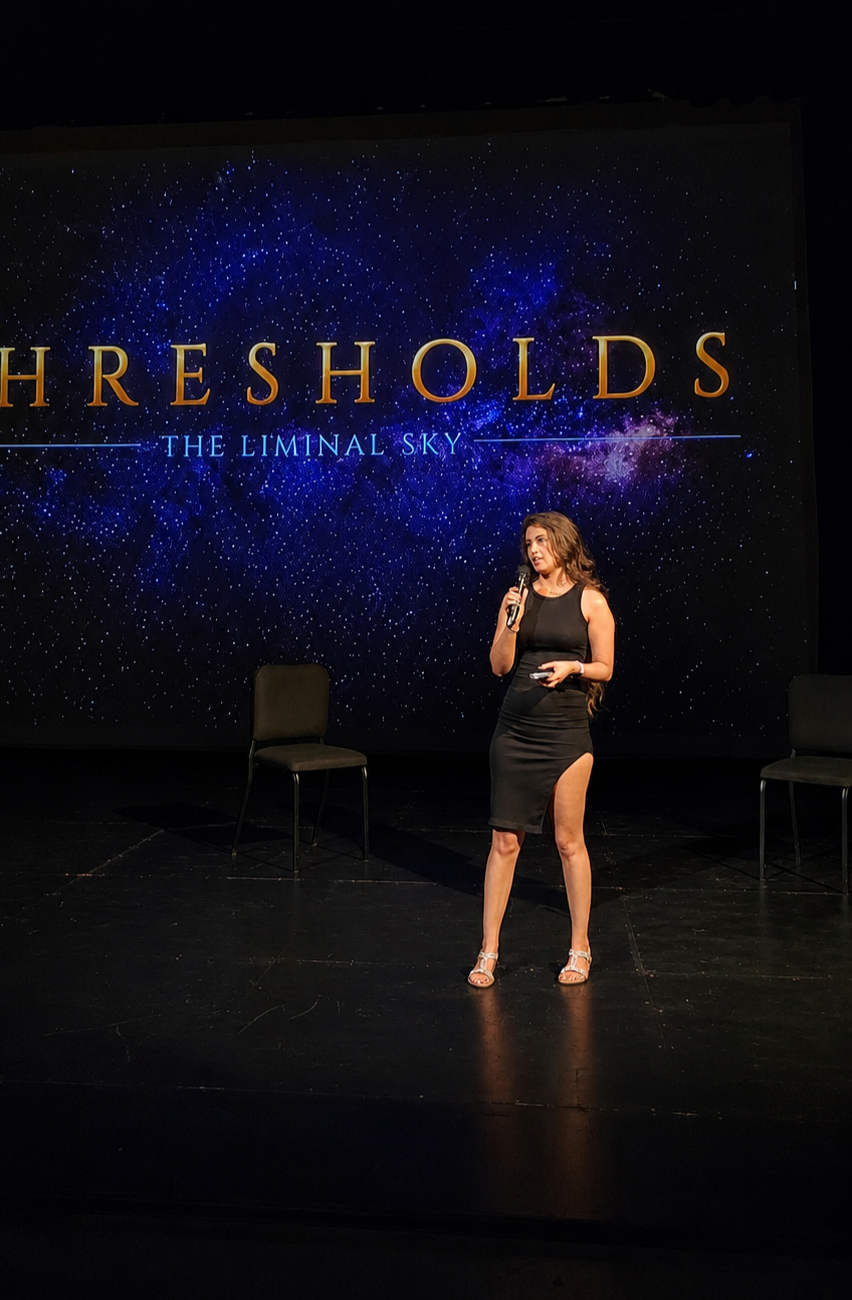
On the evening of June 19th, I stood in front of a theater of people at the Center for the Arts Kayenta just outside St. George, Utah, and did something I've never done before — I talked about my work. Not in the way artists sometimes do, casually deflecting with "I just make what I want." I mean I really talked about it. The why. The how. The parts that are still unresolved.
Before I spoke, we screened a short film called RE (by Wendy Womack): a touching, devastating story about two sisters attempting to find each other again after both escaping a cult. By the time the lights came up, the room was already tender. Already open.
And then I walked out and sat in a chair.
Two Chairs
I'd set up two chairs on the stage, first thing. Facing each other, angled slightly, not like an interrogation, more like two people trying to look at the same thing together.
I sat in one. Said nothing. Moved to the other. Said nothing. Then stood up and began.
Those chairs are for you, I told the room. One chair is the you before. Before you learned something, or unlearned something. Before the loss, the leaving, the conversation that changed the shape of your life. And the other chair is the you after.
What happens in the space between those two chairs? That's what the Thresholds is.
The film we'd just watched showed two people trying to find each other across a wide distance. What I've come to understand through making this work is that sometimes that distance doesn't exist between two people. Sometimes it lives entirely inside one person. Inside the gap between who we were and who we're still becoming.
Thresholds Come in All Sizes
Not every threshold is heavy. Some announce themselves loudly, obviously, and I showed the audience photographic evidence of one of mine. Let's just say puberty was a threshold I did not consent to, and leave it at that.
Moving to a new place is a threshold. So is turning thirty, or hearing a song that sends you somewhere your brain doesn't have words for. We cross small thresholds constantly without noticing, and then occasionally a large one arrives and rearranges everything.
My husband talks about something he's working to unlearn; black and white thinking. Point A to point B. But thresholds aren't that clean. They're a slow dissolve. A blend. You don't always know you've crossed one until you're already on the other side, looking back.
My paintings live in that blend. A galaxy softening into a landscape. The cosmos bleeding into something familiar. Vast and strange and somehow like home all at once.
The Ones That Pull You Back
Trauma is a threshold I spent some time with honestly that night.
I told the room that I'm not sure there's a clean point A and point B with trauma. I'm not sure we ever fully leave one chair for the other. I recently had something pull me back, back to a wound I thought I'd already healed, a version of myself I thought I'd crossed past. And I kept asking the question people always ask: shouldn't I be over this by now?
Maybe a piece of us never fully leaves. Maybe healing isn't a line you cross once. Maybe it's something you return to, in different light, each time understanding it a little differently.
Death came up too, as it often does in my work. And I know that can sound morbid. But I've never seen it that way. Death has always felt to me like the ultimate threshold. The one we know the least about. And that unknown is exactly what keeps pulling me toward it in the work. Not darkness for its own sake, but the deep fascination with the crossing.
How the Work Actually Happens
People sometimes assume artists begin with a message. That we sit down with an intention and build toward it. For me it rarely works that way.
What usually happens is this: I'm going about my life, doing something ordinary, and the back channel of my mind turns on. An image surfaces. Sometimes it passes. Sometimes it doesn't. It gets clearer and more insistent until I have to make it.
It's not until I'm in the middle of making it, or sometimes after it's finished, that I begin to understand what it was actually about. The parallels to my own life start surfacing. The meaning reveals itself.
I think I process life in abstract form first. My subconscious works in images before my conscious mind has language for what I'm feeling. And the painting is what comes at the end of that translation.
The art isn't the message. The art is how I find out what the message was.
The Materials Are the Meaning
The Thresholds collection is built from fiber optic strands woven directly into the painted surface, preserved botanicals I grow myself; hibiscus, orchids, crystals, resin, and mica. When the lights are low, the paintings transform. The fiber optics glow from within. The work becomes something different in the dark than it is in the light.
That duality is intentional. Both versions are real. Which one you see depends entirely on where you're standing, and what light you bring with you.
As a Utah-based fiber optic artist, the material choice has never been purely aesthetic. Light embedded in darkness — that's the whole conversation. That's the threshold made visible.
What I Hope the Work Does
At the end of the talk I asked the room one last question, not out loud, just something to carry into the gallery with them.
If the you from chair B, the version of you after you’ve passed whatever Threshold you’re in right now, could see you in chair A, what would they say?
Then I sent them into the gallery.
That's always the hope. Not that the work answers anything, but that it creates enough space for the right questions to surface. The ones you didn't know you were carrying.
Thresholds: The Liminal Sky is on view at Center for the Arts Kayenta in St. George, Utah through June 30, 2025. To view the full collection online, visit the Thresholds page.
