
What Happens Inside a Resin Pour: A Mixed Media Artist's Process
People ask me all the time what it's actually like to make one of my pieces — and honestly, it's kind of hard to explain without just showing them. But I'll try. Because the process is a huge part of why these paintings exist the way they do, and why no two are ever the same.
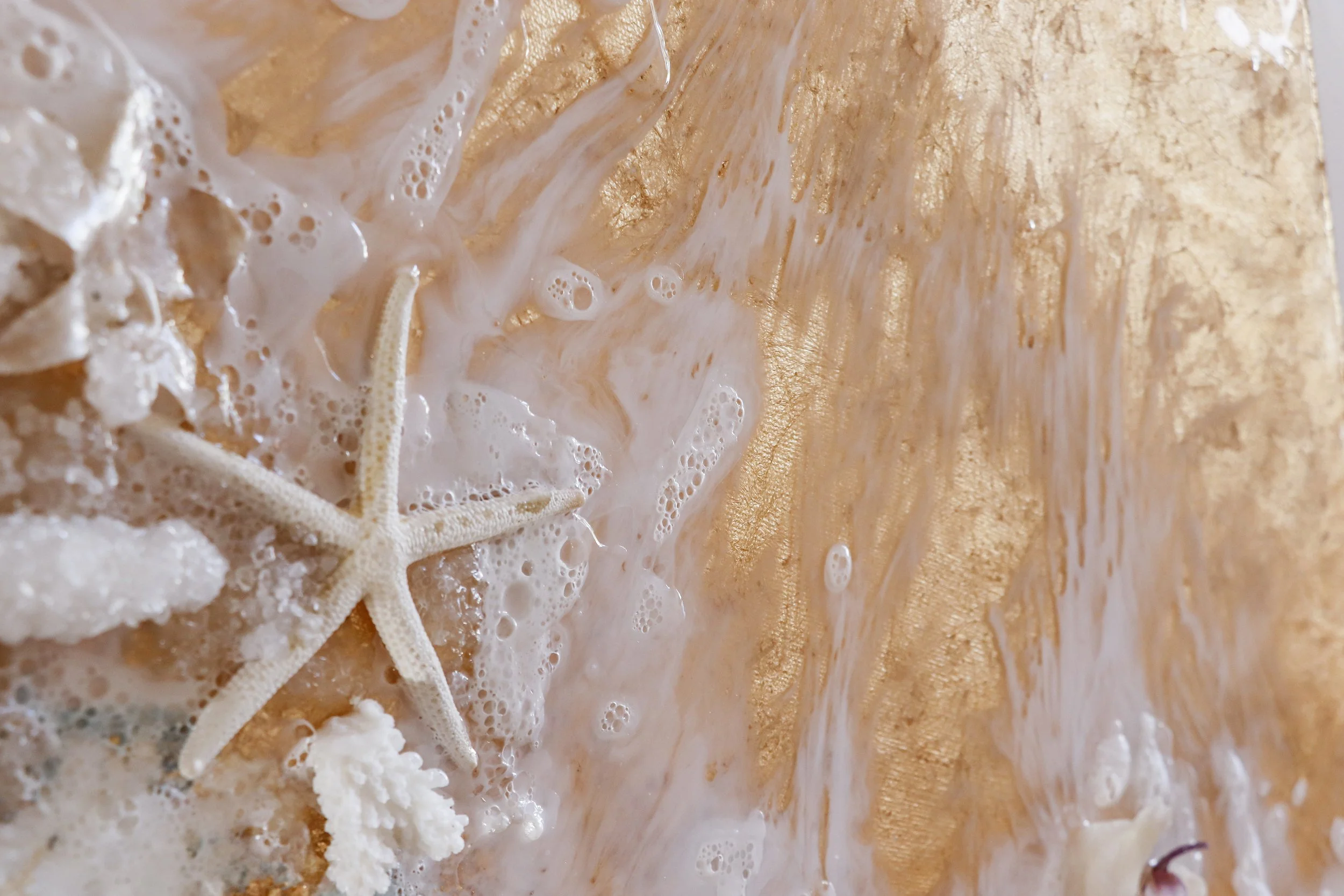
Close up detail photo of resin waves
Let me walk you through a resin pour from the beginning.
It starts the morning of. I'm not a morning person when it comes to art— I need time to think and wake up, drink coffee, unload my thoughts. So in the morning I simply lay out the materials and plan the composition. Crystals sorted by color and size. Flowers that have already been dried and sealed in resin, ready. Mica powder in different shades depending on what the piece is asking for. Fiber optic strands are already in place on the back of the piece if the it calls for light. I don't plan every placement — but I do hold the intention for the piece before I ever touch the surface.
In the afternoon, once I’ve had time to fully wake up, I mix the resin. There's a very specific ratio, a very specific temperature, and a very specific amount of time you have to work before it starts to set. That window is everything. It's where the art happens. Nothing can interrupt this process once it’s been stirred, because the clock has started ticking.
I have had cat fiascos, a strangers dog showing up in my yard I see through the window, my husband once had to be driven to the ER during a poor after slicing his thumb working on his own projects (luckily that specific scenario I had just laid the last flower and knew it would be ok). But everything else, must wait.
I start with the base layers — pouring, tilting, coaxing the resin across the canvas. The colors are added in stages. Mica gets folded in like watercolor, except you can't fully control it, which is the point. You guide it. You don't command it. Some of my most loved effects have come from a moment I didn't plan.
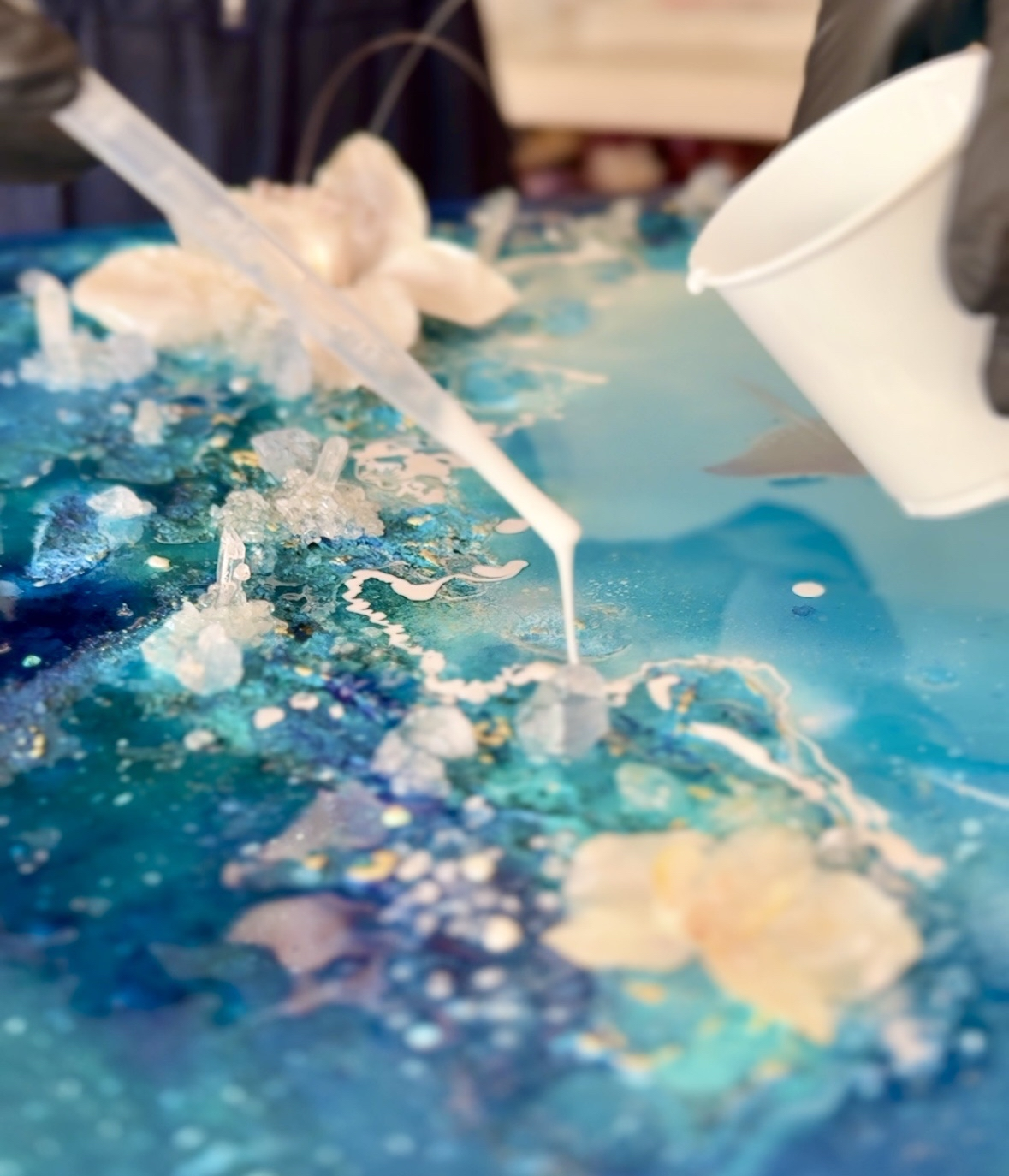
Close up detail photo of resin pour mid process for Saltwater Constellations
Then come the inclusions. This is where I place the crystals, the preserved flowers, the seashells. Each one is set deliberately — pressed into the resin at the exact right moment so it suspends rather than sinks. Too early and it falls to the bottom. Too late and it sits on top like an afterthought. The timing is everything, and it comes from feel, not a timer. Some of the crystals that sit up right were glued to the canvas before the resin, just to keep them in place.
If the piece has fiber optics — like my piece Body of Starlight — those go in before the pour, so that when the resin cures and the light source is connected, the piece actually glows from within. It's one of the most technically demanding things I do, and one of the most magical to watch come together.
If it’s a piece that requires texturizing resin, like adding the ripples of waves, this is even more of a specific sweet spot in timing I have to hit. I have to wait at least 4-6 hours after the pour. When the resin is still moldable, but not so wet that it just levels itself flat again. This window is tricky because it’s usually right before it becomes too cured to move.
The piece then cures for 24 to 72 hours. I don't touch it. I check on it. I watch it settle. Make sure the cats aren’t bothering it. Sometimes something shifts in a way I love. Sometimes I panic. Sometimes I hold my breath. But once it's done — once it's fully set and I can see what it became — that moment is unlike anything else.
Every piece I make is a collaboration between my intention and the material itself. It’s why I switched from portrait painting, the thing I got my Bachelors degree in, to abstract art. I needed something I could learn to be loose with and let go of control. This way instead of gripping so tightly to the way a thing must be depicted, I’m more so allowed to let it flow.
If you've ever been curious about what it takes to bring one of these pieces into the world — now you know a little more. And if you're thinking about bringing one into your home, I'd love to talk to you about what that process looks like too.
